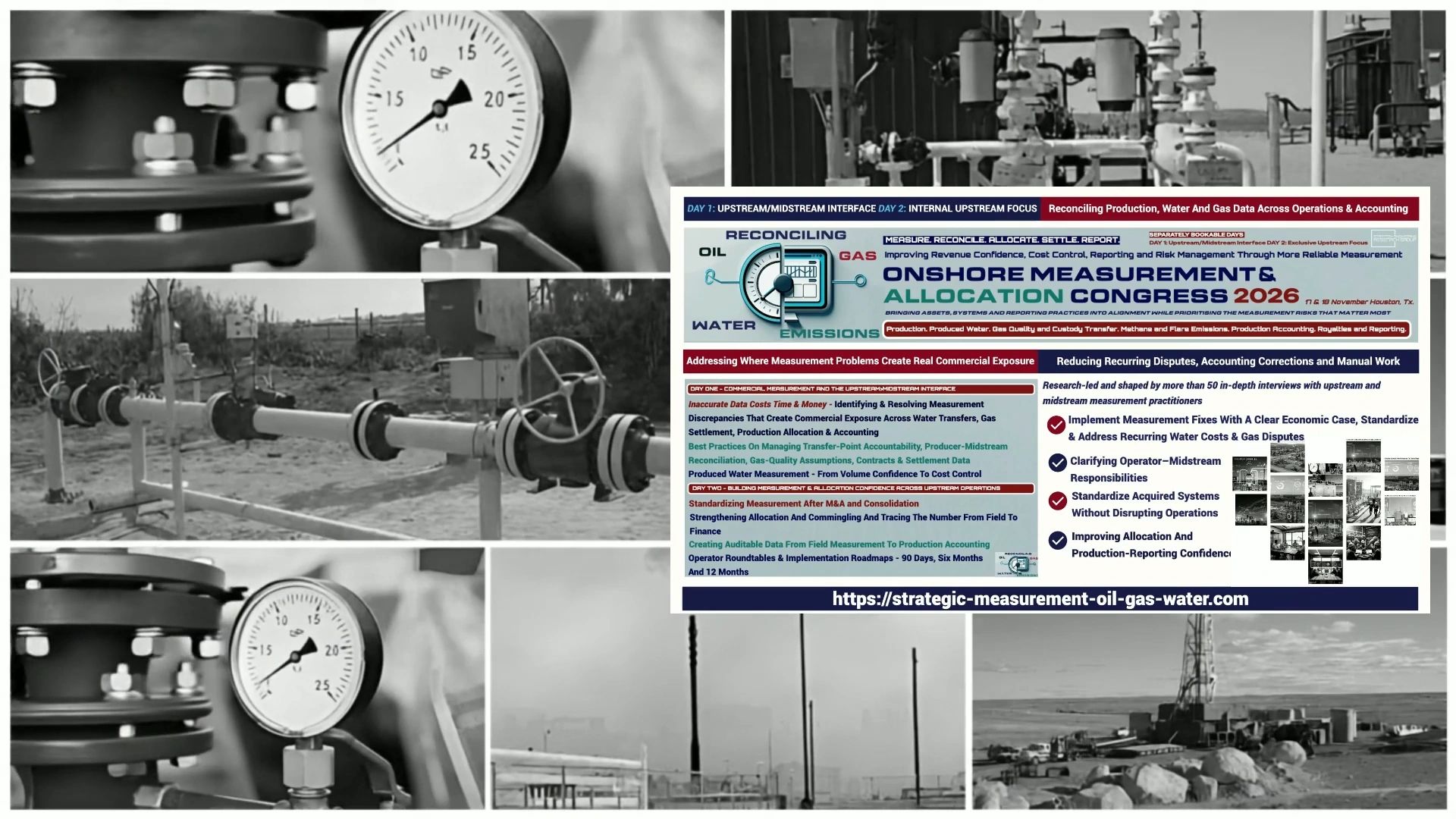
To help put this event together, we spoke to nearly 50 upstream and midstream oil and gas operators, principally operating across the Permian, with additional conversations across the Eagle Ford and Bakken as useful benchmarks. We also spoke to some regulators and solution providers.
Most of the people we spoke to already understand that measurement problems can have real financial consequences. The more difficult question is what to do about them.
Operators cannot afford to fix every meter, investigate every variance or standardise every legacy workflow — particularly medium and smaller operators working with limited engineering, measurement and production-accounting resources.
As one Head of Measurement Governance and Economic Prioritisation at a large multi-asset operator across Texas and New Mexico put it:
“We cannot fix every meter, workflow and variance. The real question is which measurement issues are financially material enough to audit, standardise or upgrade — and which ones are simply noise.”
A Midstream Commercial Settlement Manager made a similar point:
“Small variances can work both ways, and on their own they are not automatically a major problem. But if a variance repeatedly impacts a statement, an invoice or a contract, the cumulative commercial exposure can be much more important than the percentage difference suggests.”
Hear Examples Where Operators Of Every Size Are Strengthening Measurement Integrity Where Commercial Exposure Is Greatest
That is why Day One begins by comparing how operators of different sizes are prioritising measurement risk where the business exposure is greatest.
A large or recently consolidated operator will look at how inherited meters, allocation practices and workflows can be mapped and ranked following an acquisition. A medium or smaller operator will tackle the same problem from a different angle: where can limited measurement dollars actually produce a return?
Determining Whether Methane and Flare Data Uncertainty Requires Better Measurement, Stronger Documentation Or Operational Follow-Up
The same thinking led us to include measured, estimated and assumed methane and flare data in the opening part of the programme.
With New Mexico already creating a much stronger requirement for defensible gas-capture and flare information, and with the wider reporting landscape continuing to develop, several interviewees made the point that operations cannot maintain one version of the truth while environmental reporting maintains another.
Small Differences At The Producer–Midstream Interface Can Become Big Commercial Issues
We also spent a significant amount of time discussing what happens where oil, gas and produced water leave the operator and enter a midstream or third-party system.
Take a simple gas example.
A 0.25% difference across a 100 million standard cubic feet per day handover represents 250,000 cubic feet per day. At one transfer point, that may be manageable. But when small recurring differences appear across multiple transfer points, months and counterparties, it becomes easier to understand why tolerance, ownership, reconciliation and escalation become commercial issues rather than simply technical ones.
Produced water creates the same problem from the cost side.
On a system moving 100,000 barrels per day, a 1% difference represents 1,000 barrels per day, or 365,000 barrels over a year. At only $1 per barrel of gathering or disposal cost attached to that difference, that is $365,000 of annual cost exposure.
Even half of one percent can therefore matter.
An equally important research finding was that the meter is not necessarily the problem.
A producer and midstream company can have perfectly functioning meters and still disagree because of:
- different production cut-offs;
- temporary routing;
- inventory movement;
- estimated data;
- field-ticket timing;
- contract interpretation;
- different effective dates;
- or simply uncertainty over which record is meant to govern the transaction.
That is why we have not responded by putting on a generic custody-transfer session.
Mapping The Transfer Points That Carry The Greatest Commercial Risk
Instead, an entire Day One block looks at how producer–midstream handoffs actually work — mapping critical transfer points, confirming meter and data ownership, comparing contractual definitions, understanding legacy systems and building clearer routes for reconciling material differences before they reach invoices, statements or settlement.
When The Volume Agrees But The Value Does Not
Another issue that came through strongly in the research was that gas measurement cannot stop at volume.
Operators talked about circumstances where the physical volume may broadly reconcile but the eventual commercial value still differs because of:
BTU
composition
sampling
H₂S and CO₂
treating
shrink
plant fuel
residue gas
NGL recovery and allocation.
This becomes particularly difficult following acquisitions, where a consolidated portfolio can contain different sampling practices, BTU assumptions, handoff points, midstream contracts and long-standing local ways of working.
Several respondents told us that part of the challenge is simply reconstructing how the producer's measured gas becomes the final settlement statement.
Importantly, we are also bringing the midstream perspective into that discussion.
One of the consistent requests from upstream respondents was to better understand what can legitimately change within the midstream system, rather than assuming every difference represents an upstream measurement failure or a midstream error.
Ensuring Produced Water Numbers Stand Up Commercially And Regulatorily
Produced water generated enough discussion during the calls for us to give it a substantial dedicated block.
The issue is not simply measuring how much water leaves a lease.
Operators increasingly need to reconcile water across:
production → transfer → storage → recycling → gathering → disposal
and explain why those numbers do — or do not — agree.
The case studies work through transfer-meter records, storage and recycling data, disposal-well information and gathering or disposal invoices, asking what must be compared before challenging a difference and how operators separate genuine meter error from timing, routing, inventory and billing issues.
The session also asks the practical question:
Which measurement record governs commercially — and which record has to stand up for regulatory purposes?
Day Two Moves Inside The Operator — Where Measurement Meets Allocation And Production Accounting
Once we move away from the producer–midstream interface, the research raised a different set of problems.
Several conversations focused on what happens when measurement data moves through allocation, commingling and production accounting inside the operator.
Shale consolidation has made that harder.
Operators can inherit different allocation methods, different meter hierarchies, different shared facilities and different approaches across basins and operating teams.
The question is not necessarily whether one method is theoretically better than another.
It is:
Which controls really need to be consistent across the portfolio — and where do different facilities, asset types and operating realities genuinely justify different approaches?
That is why Day Two opens with measurement and allocation after M&A, followed by a joint measurement and production-accounting case study around reducing revenue leakage and repeat monthly corrections.
The programme specifically looks at improving the handoff from field measurement into production accounting, controlling exceptions, simplifying allocation assumptions and reducing the amount of recurring manual correction required at monthly close.
And Finally — Does The Problem Actually Require Another Meter
The conference then comes back to the question with which the research started.
What is actually worth fixing?
One of the strongest messages we heard was that many measurement problems are indeed measurement issues — but they are not necessarily metering-technology issues.
The root cause may be:
- equipment performance;
- routing;
- temporary configuration;
- master data;
- field-ticketing;
- contract interpretation;
- incorrect effective dates;
- substituted information;
- human error;
- or a workflow that allows the same discrepancy to recur every month.
That is why we have deliberately moved away from making this a purely technology-led conference.
Technology will still be discussed throughout the two days, because the type of meter, proving method, sampling system, telemetry and automation clearly matter.
But we also want operators to avoid buying technology before they have diagnosed the problem.
That thinking shapes the final conference session.
Rather than finishing with another presentation, operators will work through real measurement scenarios and ask:
Should this be fixed at source?
Can it be reconciled downstream?
Would automation remove repetitive work?
Does the evidence standard need strengthening?
Is a hardware upgrade justified?
Or should the operator consciously leave the existing system alone?
The closing block brings together risk-based assurance, root-cause analysis, targeted automation and practical improvement planning, including what an operator might realistically change over the next 90 days, six months and twelve months.
That brings the programme full circle.
We start by asking which measurement problems materially affect the business, spend two days examining where those problems arise and how different operators are addressing them, and finish by asking what practical action is actually proportionate to the exposure.
There will be a great deal to discuss and, we hope, plenty of real examples for operators to compare.
At this early stage, we would again like to thank the upstream and midstream operators, regulators and other industry participants who gave their time to help shape the programme.
Their input has directly influenced both the issues being discussed and the way the sessions have been structured.
We look forward to welcoming many of them — and hopefully many of you — to Houston this November.